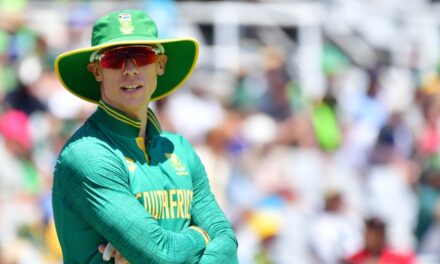

Marques Ackerman has revealed how defensive discipline, an understanding of his strengths and the ability to adapt to different conditions have been central to his record-breaking start as a Proteas Test opener.
The left-hander made history during South Africa’s innings and 219-run victory over Bangladesh in Centurion, reaching 150 off just 137 deliveries – the fastest Test 150 by a South African.
Having scored successive 150s against Bangladesh, Ackerman has brought a different dimension to the top of South Africa’s batting order.
However, behind the expansive strokeplay and willingness to disrupt bowlers’ lengths is a considerable amount of work on the fundamentals of batting.
“People obviously see me scoring really quickly, but I put a lot of effort and work in the nets and behind closed doors,” said Ackerman.
“Obviously, it’s nice to get some runs behind it to back it up, but to be honest, I felt like I left really well, I defended really well when they were in a good area.
“So I feel like even when I walked down the wicket into the channel to try and put the bowler off their lengths, when the ball was in a good area, I still managed to leave well, I still defended well.
“So in between all the attacking shots and maybe sometimes doing some really questionable things, I still feel like my defence and my leaving was really good, which puts pressure on the bowlers and maybe that does make them feel like they need to change their lengths or go searching a little bit more.”
Understanding His Strengths
Ackerman’s desire to play differently stems from his formative years as a young cricketer growing up in Johannesburg.
Being physically smaller than many of his peers, he recognised the importance of finding ways to distinguish himself and compete against bigger players.
“I was always the smallest guy in my age group growing up. Growing up in Joburg, there’s a lot of good cricketers, a lot of good schools, and I wanted to be different.
“And how was I going to be different? I was going to make sure that I have to stand up for myself. I’m the smallest, I’m going to have to compete with the bigger guys. I have to stand up for myself, and that for me was a big turning point.”
Interestingly, despite establishing a reputation as one of South Africa’s most aggressive top-order batters, Ackerman dedicates much of his preparation to his defensive game.
“Do I work hard on all the expansive shots? Probably not as much.
“It’s more my defensive game, leaving well, getting into good positions, working with a batting coach, stuff like that.”
Ackerman also works closely with Proteas analyst Brendan Kleynhans, studying footage and identifying small adjustments he can make between innings.
However, he is conscious of the dangers of becoming too consumed by technical imperfections.
“I don’t want to tinker too much with my technique and all that stuff because every batter has got a flaw. I’ve got loads of flaws, and that’s okay.
“I think if you make peace with that and rather look at the strengths that you have, then it will go a long way.”
Knowing When to Transfer Pressure
While Ackerman’s scoring rate has attracted considerable attention, backing his natural game does not necessarily mean attacking regardless of the circumstances.
He pointed to his Test debut at St George’s Park as an example of his willingness to adapt to challenging batting conditions.
“The wicket was really spicy, and I knuckled down, didn’t play an expansive game. I knew the team needed me to just bat a little bit, soak it up a little bit more, left well, defended well.
“So I think it changes all the time. You’re going to get wickets where it’s really spicy, you’re always facing a new ball against good bowling attacks. So it changes all the time depending on the conditions.”
For Ackerman, the ability to recognise when conditions are in his favour is equally important as knowing when to absorb pressure.
“But when the conditions are in your favour, I feel like then you’ve got to cash in and put the bowlers under pressure and transfer pressure back onto guys, especially against good bowling attacks.
“And I feel like every country’s got a good bowling attack at the moment in world cricket. They’re all human, they also feel the pressure, so why not put them under pressure when the opportunity is there?”
The Conversation With Conrad
Perhaps the most remarkable aspect of Ackerman’s introduction to Test cricket is that he had never opened the batting in red-ball cricket before taking on the role for South Africa.
However, a conversation with Proteas head coach Shukri Conrad during a South Africa A tour of England gave him an opportunity to prepare for that possibility well in advance.
“He said, ‘Listen, Ackie, there might come an opportunity for you in the Test team. It might be something you’re not used to, it might be opening.’
“‘I wouldn’t give you an opportunity if I didn’t think you could do it, and I know you can do it and you are capable of doing it.’”
That conversation prompted Ackerman to spend more time facing the new ball in the nets, ensuring he would be prepared should the opportunity arise.
“If that opportunity comes at the opening, I’m going to take it with both hands because I waited 10 years for it, so who wouldn’t want to take it?”
Why the Timing Was Perfect
After years of performing in domestic cricket and waiting for international recognition, Ackerman admitted there were moments when he questioned whether his opportunity would ever come.
However, rather than viewing those years as lost time, he believes they were crucial to his development as a batter.
“I feel like I played a lot of SA A cricket. I ended up scoring a lot bigger scores in my career. I learned how to score bigger scores.
“I learned how to play my attacking brand of cricket and being able to extend big scores. So I think that was a crucial period in my career, even though you can say you should have played earlier, but I think the timing has been perfect.
“I’ve got the experience that I wanted, and now it’s all about being able to deal with whatever is in front of me and also when you are failing, to get back to your best quicker.”
Fatherhood and stability away from cricket also helped him develop a different perspective on his international ambitions.
“So yes, I did think at times that maybe it will never come, but I think my life was at a stage where having a little one, having a second one on its way, my life was stable at home. If I get the opportunity, I get it. If I don’t, it’s not going to change my life a heck of a lot.”
Despite his remarkable start as a Test opener, Ackerman remains under no illusions about the challenges that lie ahead.
“I’m a realist, and I know that opening the batting in Test match cricket is not going to be easy all the time.”
He believes his performances against Australia and Bangladesh have given him a valuable reference point to return to when he encounters a difficult period.
It is an approach built on understanding what makes him successful rather than abandoning his identity as a batter when results go against him.
And for someone whose aggressive batting could easily make him a role model for aspiring T20 cricketers, his advice to the next generation is particularly interesting.
“The transition into T20 cricket and white-ball cricket does become a little bit easier because your fundamentals are really good.
“So yeah, I would still encourage kids and younger people to really focus on playing red-ball cricket because that is what cricket really is about for me.”
Want a deeper understanding of South African cricket? Subscribe to CFM Weekly, our free Friday newsletter, using the form below.