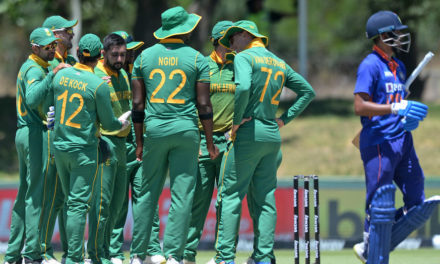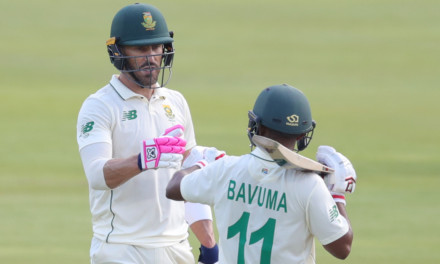

South Africa’s ability to find different match-winners has been one of the defining characteristics of their recent success in Test cricket, according to Simon Harmer.
Ahead of the first Test against Australia at Kingsmead, much of the attention has naturally turned towards conditions in Durban and whether the Proteas could field Harmer alongside Keshav Maharaj.
But for Harmer, there is something bigger behind South Africa’s recent success.
He believes the current Proteas side has developed an ability to problem-solve when Test matches move against them – without depending on a handful of individuals to rescue the team.
“Since being back in this Test set-up, it’s a group of guys that always find a way.
“I think there’s a common purpose and everybody’s pulling in the same direction. It’s a very close group.
“So I think when things do start to go awry, there’s the willingness to fight for your mate next to you, which has been amazing to see for me coming back in.”
‘Test match cricket is like a game of chess’
That quality was evident when South Africa defeated Australia in the World Test Championship final.
Harmer believes the ability to respond to difficult periods is particularly important in Test cricket because momentum can shift repeatedly across five days.
“I think that’s probably the strongest trait, is being able to find ways to win because Test match cricket is like a game of chess and you’re going to have periods, sessions, hours where things don’t go your way and it’s about problem-solving and finding solutions to that.
“I think it’s one thing that this team has done exceptionally well in recent history.”
Harmer’s perspective is particularly interesting because he has experienced two different eras within the Proteas Test setup.
During his first spell at international level, South Africa had some of the biggest names in world cricket.
“Previously there were a lot of – and I mean this in the most respectable way possible – you had big names, AB de Villiers, Hashim Amla, Dale Steyn.
“These guys could win games on their own and they did that for South Africa time and time again.”
Harmer sees a different dynamic in the current group.
“Where I feel the squad at the moment, it’s a team effort.
“It feels like every time we win, it’s somebody else putting up their hand. There’s not this reliance on certain individuals. If they do well, we do well.
“And I think that’s probably the difference from the first time that I got into the national set-up to where this team is now.”
Harmer has changed too
The Proteas environment isn’t the only thing that has changed since Harmer’s first period in international cricket.
At 37, the spinner believes he understands the emotional demands of performance sport considerably better than he did earlier in his career.
“I think just dealing with the expectation and the pressure, understanding what international cricket is about, being a little bit older, going through success and failure at county level and domestic level.
“I think I was extremely determined to do well when I got my first opportunity and I probably ended up putting too much pressure on myself.”
That pressure meant performances could have a significant impact on him.
“It was either very high or very low where I think now, being 37, I’m kind of aware how things go to performance-based sports and I’m going to have good days and bad days.
“So, that’s probably been the biggest change for me.”
Harmer has played considerable cricket since his first experience with the Proteas, exposing him to different conditions and challenges.
But he believes the biggest development has been internal.
“I think obviously playing a lot of cricket has helped me gain experience in different conditions, but I think if I was to pinpoint one thing, it would just be that, just being a bit more level.”
Could Kingsmead bring the spinners into the game?
Whether Harmer gets an opportunity in Durban could depend on the balance South Africa choose for the opening Test.
Traditionally, he believes South Africa’s coastal venues can offer something for spin.
“I think like traditionally the coastal wickets do offer more assistance for the spinners.
“If I think back to the Bangladesh series, there was a bit of turn on offer there, but then against the West Indies at one reserve there was also a turn on offer.
“So, as a spinner, I obviously hope it turns, but I think the general rule of thumb is that the coastal wickets do offer a bit more for spinners.”
Importantly, spin in South African conditions does not necessarily behave in the same way as it does on the subcontinent.
For Harmer, one of the biggest differences is bounce.
“The bounce probably, so similar to Australia.
“I think back again to that Bangladesh series, I feel the subcontinent players play with very low hands because the ball doesn’t bounce as much.
“So, there was a lot of balls off the glove in that series. So, that would probably be contact points.”
The difference can also affect how batters approach scoring shots.
“I think non-subcontinent players probably play out in front of their body a lot more than the guys from the subcontinent do.
“They like to play the ball nice and late. I think if you look at how guys cut, it’s almost out of the wicketkeeper’s glove behind point where we generally try and murder it in front of square and get one.
“So, that’s probably the biggest difference for me.”
Harmer and Maharaj could offer different threats
Should South Africa decide to select both Harmer and Maharaj, their partnership would not simply involve two spinners performing identical roles.
Harmer believes those responsibilities can change according to the batters at the crease and the situation of the match.
“Look, every game is different. It’s about understanding the situation.
“If there’s two left-handed batters and we’re bowling together, then potentially I would look to be more aggressive and Keshav would look to hold.
“Not that that would be his role, but you know what I mean? There’s different stages in the game where I think you need to identify what your role is, what you need to do and what the team needs.”
Harmer is also looking to use Maharaj’s considerable experience of South African conditions.
“Conversations with him have been more around conditions, how do you look to bowl certain balls, what are you looking to try and do.
“He’s obviously got a wealth of experience, so I’m going to be trying my best to tap into that as much as possible.”
With several left-handers potentially featuring in Australia’s batting lineup, Harmer’s off-spin could provide an interesting match-up.
But he cautioned against assuming that automatically makes him the greater threat.
“As a right-arm spinner bowling to a left-hander, you hope that it turns from straight.
“And if the wicket is good, which it should be, you could potentially see that it’s actually Kesh who is more threatening against the left-handed batters and myself to right-handed batters.
“So, I hope that it turns from straight and if it does, then, yeah, I really want to be able to put my hand up and break partnerships.”
Australia expected to respond to spin challenge
Australia’s difficulties against spin during the preceding ODI series have inevitably become a talking point.
Harmer, however, does not expect what happened in the white-ball matches to simply transfer into the Test series.
“I think based on the one-day series, they didn’t play it as well as they probably would have wanted to, but I think Test cricket is a completely different kettle of fish.
“I think there’s also different personnel that come into their Test set-up.
“So, from my perspective, I can only focus on what’s there. There’s not too many transferable players into the Test set-up than the one-day set-up.
“So, I hope they don’t play it well, but we’re expecting them to play it well.”
One of the players returning to Australia’s Test batting lineup is Steve Smith.
For Harmer, the prospect of bowling to one of the world’s leading Test batters is something to embrace.
“He is one of the world’s best Test batters and extremely good against spin.
“He wasn’t part of the White Ball series and I’m sure he’s extremely hungry and been doing a lot of prep for the series.
“So, yeah, I’m really looking forward to the opportunity to get into the battle with him.”
Lyon provides a threat of his own
South Africa’s batters will have their own spin challenge to solve in Nathan Lyon.
Harmer has followed the Australian off-spinner closely and believes Lyon’s combination of pace and revolutions makes him particularly difficult to face.
“He’s a world-class bowler and one of Australia’s best spinners.
“He gets a lot of action on the ball. His stock pace is quite quick, which forces a batter to commit to a shot.
“Sometimes, if it’s too slow, a batter can play the ball off the surface, but I think he forces batters to make decisions and then because of the amounts of revs and action he gets on the ball, he gets a ball to sort of drift away and gets batters into trouble.”
Harmer has studied elements of Lyon’s bowling over the years.
“There’s certain ways that he does things that I’ve looked into and what makes him so successful, what makes him able to bowl at those speeds and still have good shape on the ball.
“So, yeah, definitely somebody that I’ve followed and enjoy watching bowl.”
Australia will ‘fight to the death’
Whatever role spin ultimately plays at Kingsmead, Harmer expects another fierce contest between two teams that have already met on some of cricket’s biggest stages.
“The Australian team is always extremely competitive. They fight to the death. Their lower order always seems to score a lot of runs.
“They fight till the end, which I think is quite a similar trait to South Africans. We’re resilient and we probably do our best when our back’s up against the wall.”
South Africa’s World Test Championship final victory provides another layer to the contest.
“I think that was for the world to see in the World Test Championship final. I think it was almost a foregone conclusion that Australia were going to win that game, but the team found a way to get through it and to get the win.
“I’m sure Australia wants a bit of revenge from that loss and I expect them to come out firing and being competitive.”
Franchise cricket may have softened some of the personal rivalries that existed between international players in previous generations, but Harmer does not expect that to reduce the intensity.
“I think T20 has softened that a little bit.
“But I don’t expect them to be soft by any stretch of the imagination.”
For South Africa, that provides another problem to solve.
And if Harmer’s assessment of this Proteas side is correct, solving problems when a Test match becomes difficult might be exactly what they do best.
Want to experience South African cricket beyond the headlines?
Every Friday, CFM takes you deeper into the stories, conversations and decisions shaping South African cricket.
Get the CFM Friday Edition free in your inbox.
Sign up using the form below 👇