Orographic rain happens when clouds, who are going about their business quite happily, being pushed along their way by the wind, come into contact with immovable objects like mountains.
As most of you will know (if you read my last article), Newlands Cricket Ground is possibly most loved for its proximity to the Table Mountain Range, which is on the western side of the ground. How often in a great thriller does the hero turn into the villain?
As the crowd swells, the villainous slopes back up the massing clouds, who continue to sprinkle their contents on those who wait. The sign on the scoreboard tells us that the toss is delayed due to inclement weather. I am wondering who this Clement guy is, and what he has done to the weather.
My musings then turn to what may happen if the game is shortened. That won’t happen unless the game starts more than an hour after the scheduled start. Then there will be a shortened game. How many overs each team may bat will be determined by the amount of time available for the match. If it rains again during the match, then there will need to be a recalculation of targets. This gets me thinking about the history of reduced overs matches.
Many years ago, in lands close and far far away, there was only Test Match Cricket. In test matches there was and is no need for a recalculation of the target. This meant that cricket authorities hadn’t needed to calculate revised targets. That all changed when somebody clever invented limited overs Cricket. There is some dispute as to whether this was invented in India in 1951 or in the UK in 1962. What we do know is that the first formal limited overs match was played as the Gillette Cup in England in 1963.
With the advent of limited overs Cricket came the challenge as to what to do if the game was interrupted by rain. From 1963 until about 1991, the method used was quite simple. The average run rate (ARR) of the team batting first was used to calculate the target for the team batting second. An example of this would be that if the team batting first scored 250 in their 50 overs, then the team batting second would need to score at a rate of five runs per over plus one run in the overs they had to bat to win the match. If the amount of overs to bat was 30 overs then the target would be 150 plus one run, 151 runs.
While this method was less than perfect, it stood the test of time for nearly 30 years. It favoured the team batting second because they would be able to bat at the same rate as the team batting first but in less overs.
After one particularly important international match was decided by this method, Australia proposed a change, the Most Productive Overs method, or MPO. This was supposed to rectify the benefit of the ARR method for the team batting second. The premise for this was that the team batting second would have to chase the best-scoring overs of the team batting first. So, if the team batting first scored 300 in 50 overs, and faced 10 maidens, then if the game was reduced to 40 overs for the team batting second, then the target would be 301 in 40 overs.
This method was famously proven to be farcical in the 1992 World Cup Semi-Final, where South Africa’s target was reduced from 22 off 13 balls to 22 off 1 ball when two overs were lost to rain. The MPO method tilted the balance too much in favour of the team batting first. It was adjusted a few times to try and rectify this, but ultimately it died with the adoption of the Duckworth-Lewis method by the ICC in 1999.
Developed by Frank Duckworth and Tony Lewis, this statistical model took into account the “resources” remaining for the team batting second. This was the first time that the match situation was more appropriately measured, taking into consideration runs, wickets and overs.
With the rise of T20 cricket, the DL method was updated in 2014 by Australian statistician Steven Stern, to give us the DLS method we know and love today. This proves yet again that the world is a better place with clever people like mathematicians.
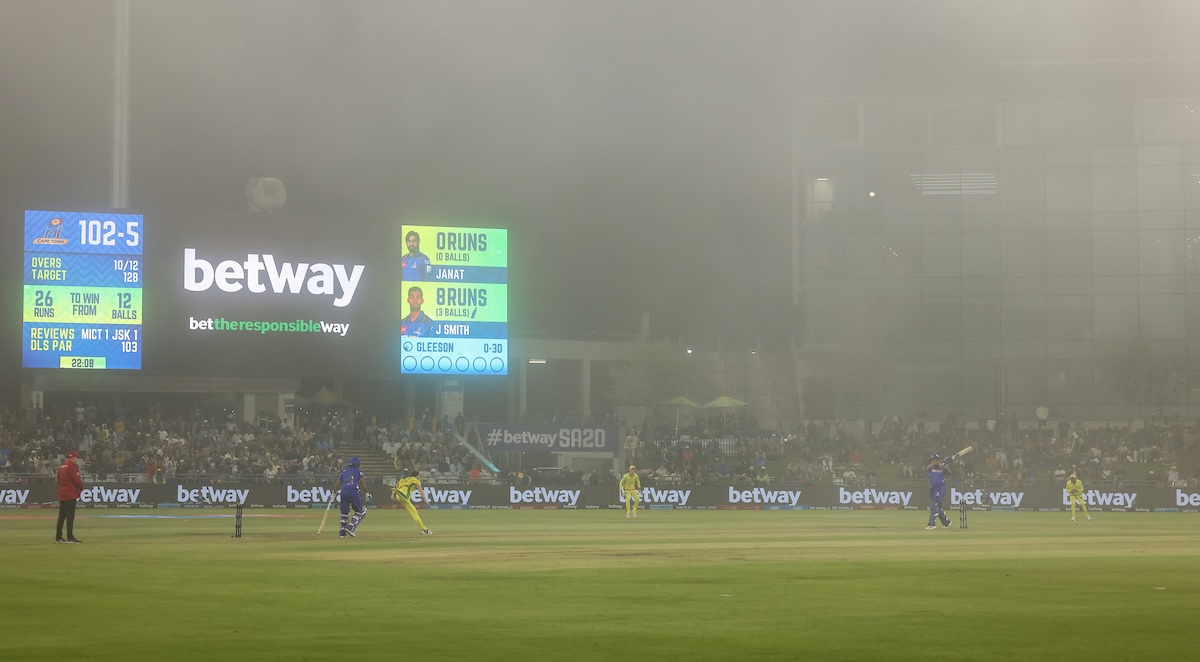
While I am penning this, the game between MICT and JSK has started and stopped and started again. The evening has developed into cricket’s version of a Harlan Coben thriller. Have the dastardly clouds become the ultimate villain of the piece? Will DLS prevail? Can MICT turn their season around? Will the Security Guards catch the fan who ran across the ground during the rain break? Does the rope pulled across the turf really disperse the water? Is Jason Smith really in South Africa’s T20 World Cup squad? Is the man in block C row B seat 26 wearing French or Italian Cologne?
Whatever happens, the thrilling season 4 of the SA20 has gripped the imagination of the SA cricketing public like never before.