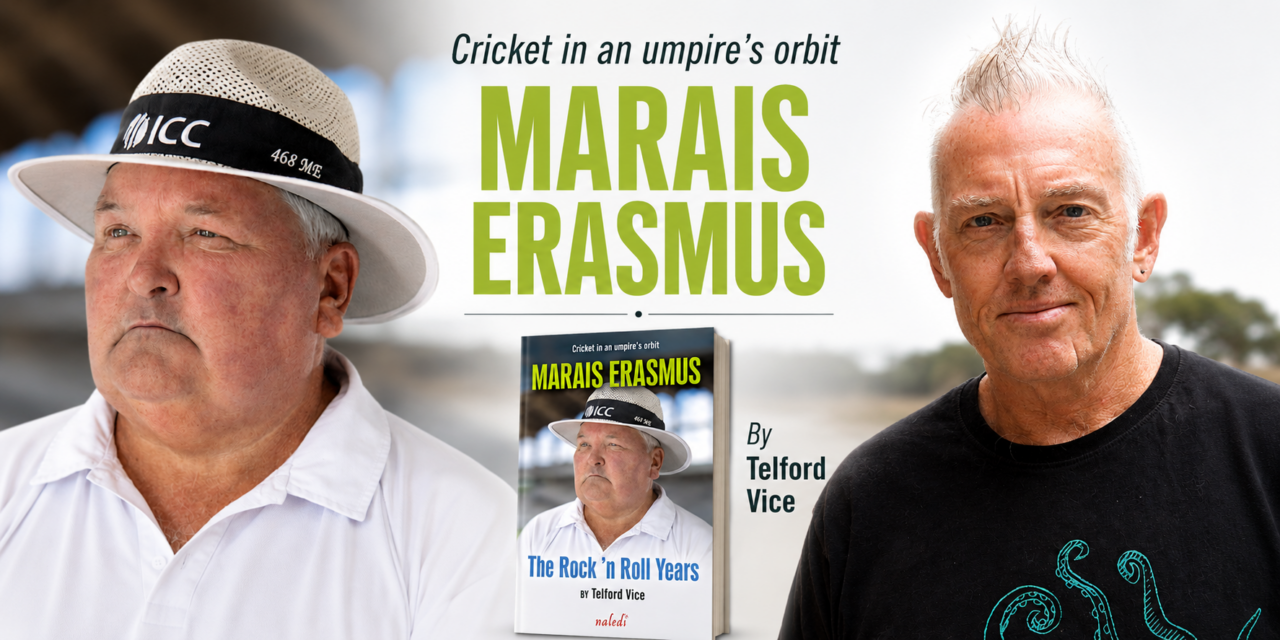
An edited extract from “Marais Erasmus: The Rock ’n Roll Years; Cricket in an Umpire’s Orbit” by Telford Vice (Naledi):
It’s July 2023 at Lord’s, and Cameron Green propels his 1.98-metre tall frame forward to bowl to Jonny Bairstow. The delivery — the last of the over — is pitched short. Bairstow ducks beneath the ball and allows it to sail into Alex Carey’s gloves. The over is up and the ball is dead, Bairstow assumes. He does not bother turning his head to look at what Carey is doing.
Bairstow wanders up the pitch towards his partner, Ben Stokes, in much the same manner as you might stroll an aisle in a supermarket looking for your preferred brand of biscuits. Wherever Bairstow’s mind is, it’s not on what’s going on behind him.
In one clean, unbroken action, Carey catches the ball and underarms it onto the stumps. By then Bairstow has dawdled a long way out of his crease. The Australians appeal, and are celebrating by the time a dazed and confused Bairstow whips his head around from side to side repeatedly, maybe desperately trying to find the chocolate digestives.
The on-field umpires, Ahsan Raza and Chris Gaffaney, confer and do the done thing — over to you, television official. Over to you, Marais Erasmus.
Bairstow stands, hand on hip, chewing his gum frantically, looking this way and that, trying to make it all make sense. Erasmus studies the footage with due care before making his decision.
Was the ball dead when it hit the stumps? Here’s law 20.1.2: “The ball shall be considered to be dead when it is clear to the bowler’s end umpire that the fielding side and both batters at the wicket have ceased to regard it as in play.” And law 20.2: “Whether the ball is finally settled or not is a matter for the umpire alone to decide. And law 20.3: “Neither the call of over, nor the call of time is to be made until the ball is dead.”
Clearly, the Australians didn’t consider the ball dead. Just as clearly, the umpire at the non-striker’s end, Raza, hadn’t called over before the wicket was broken. Even more clearly, it was not Bairstow’s prerogative to decide when the ball was dead.
That he was not attempting a run is irrelevant. What matters is that he wasn’t behind the crease when the bails lifted. There is no doubt. Erasmus pushes the button, and up it pops on the big screens: “Out.” Stumped, it should be noted; not run out.
When the on-field umpires involve Erasmus, he asks Gaffaney whether the appeal is for a stumping or a runout. What difference would that make in the way he arrives at his decision? None. “It was just to buy time as I was still trying to figure out, in my mind, if the ball was live,” Erasmus says. Remember, he has been watching the screen in front of him to check for no-balls and isn’t entirely on top of what has happened.
Gaffaney doesn’t reply. It seems his communication gizmo has failed. Having by now brought himself up to speed, Erasmus asks Raza if he called dead ball. Raza says he didn’t.
“So now I know the ball was live, and — very importantly — that Carey didn’t hesitate, that he threw the ball immediately,” Erasmus says. “In this kind of situation, umpires only ever apply the law. We cannot transgress the spirit of cricket if we apply the law. So it’s quite cold — the ball’s live, Carey played it immediately, and Jonny was out of his ground. He’s out.”
An aghast Bairstow saunters off in a cloud of dark mutters. The crowd are incensed. “Same old Aussies, always cheating,” they yell, and will do, between boos, for much of the rest of the day.
Stuart Broad, the incoming batter, storms through the tension that has enveloped the ground and arrives at the crease as upset as someone who has just missed a flight. What happens next is captured by the cameras and, more importantly, the stump microphones.
Broad glares at Carey and rasps at him like a scolding schoolboy: “That’s all you’ll ever be remembered for, that! That’s all you’ll ever be remembered for!”
Carey beams a bright smile back at Broad and quips: “Yeah, I know.”
Broad takes guard in a hurricane of huff: “Literally the worst thing I’ve ever seen in cricket, that.”
The five overs between Bairstow’s dismissal and the end of the first session pass in an atmosphere thick with febrility. Broad does his bit to fuel the smouldering unhappiness by emphatically grounding his bat behind the crease in pantomime fashion and demanding from the Aussies their agreement that the ball is dead.
So to lunch. At Lord’s that means, for the players, walking through the pavilion’s long room before ascending the stairs to their dining area. The long room is invariably packed with MCC members during a Test, and to the rafters for the Ashes. The members were ready to give the passing parade of Australians a piece of their scrambled eggs and boiled bacon minds.
The MCC does wonderful work in areas of the game far beyond Lord’s, like running coaching clinics in refugee camps in Lebanon. But, at Lord’s, and particularly inside the pavilion, you would be forgiven for thinking the clocks has stopped ticking sometime during the 19th century.
As they walk the Aussies are assailed with abuse by people who owe much of what they have to their misplaced sense of exceptionalism. The noise they make is raw, boorish and bloodthirsty. In a word, uncivilised.
The Australians, primed for what is coming by the howls from the stands after Bairstow’s dismissal, brush most of it off as they enter the long room. Some of them smile and point at the mob.
“Walking back into the long room, it was like we’d ripped the soul out of them … absolutely, people stepped over the line,” Pat Cummins said in the third season of the Amazon Prime documentary, The Test.
Usman Khawaja, who has developed a thick skin as a brown, Muslim man playing the great white game of cricket in a place like Australia, takes exception to something said to him and pauses to confront his tormentor. David Warner, no stranger to confrontations on and off the field, also has what he considers an untenable slur slung his way. We know this because, despite being among the most private places in sport, the Lord’s pavilion is riddled with surveillance cameras.
“One of them … [was] spraying me,” Khawaja said on The Test. “I was like, ’nup, you can’t be saying that stuff.’ He said ‘Oh, I can say whatever I effing want.’”
On the same programme, Marnus Labuschagne recalled: “One of them was foaming at the mouth. A bloke hit Bull [Warner] when he went up the stairs.”
There are no rabid members in the players’ dining area. But that doesn’t mean there isn’t any trouble. This is, after all, where every party to the conflict could be corralled for the best part of 40 minutes.
Bairstow steams in, still livid, sits down, and doesn’t eat. He’s too furious. An emotional player without all this, he is reduced to a catatonic silence. At least, until the drama is replayed on the televisions in the room. Bairstow takes his eyes off the screen to glare at the Australians, and barks, “You guys happy with that?”
Warner is chewing a mouthful of chicken as Bairstow speaks. He spits it back into his plate and replies, “Yeah. Very.”
The match officials take lunch in the same space. Their table is set up between the teams’ tables. That might have made them feel like referees in an impending boxing match, given the circumstances. You could have pierced the pressure with a steak, much less a steak knife.
“I had ordered my steak by the time Jonny walked in fuming and looking at the Aussies’ table,” Erasmus says. “I realised I might become a witness to something I don’t need to witness. So I took my steak and left the room. That was probably my best decision of the match.”
Would it not have been the officials’ responsibility to stop the players launching a food fight? If they had, their re-appearance on the field in gravy garlanded whites would have been interesting. But what if they had started throwing cutlery at each other? If the security staff in the long room had been unable to stop doddering MCC members from getting at the players, what chance did they have of stopping young, fit, easily agitated men from doing each other physical damage?
“In the end nothing reportable happened,” Erasmus says, but concedes “although it could have.”
“Marais Erasmus: The Rock ’n Roll Years; Cricket in an Umpire’s Orbit” by Telford Vice is available in bookshops and from Naledi’s site.