A South African, an Australian, an Englishman and a New Zealander walk into a bar, where they begin to talk about Test Cricket. It’s 1970 and South Africa’s cricketers feel like they are on top of the world after winning their last three series against England in 1965 and Australia in 1966/67 and 1969/70.
This is an anomaly for South Africa, as their Test history is not littered with victories against the old foes of England and Australia. It marks the start of the era of isolation from international cricket.
According to the Cambridge Dictionary, nostalgia is a bittersweet emotional state that combines a fond, warm affection for the past with a slight sadness or yearning because that time is gone.
For many South Africans of that era, it brings lumps to the throat and tears to the eyes as they remember the mastery of Graeme Pollock, the genius of Barry Richards, the combative Bunter Barlow and the effervescent Mike Procter. For countless others it is the tears of bitterness at being legislated out of the opportunity to represent your country.
White Cricket in South Africa in the apartheid years created its own reality, and for those, like me, that grew our love for the game in this time, isolation left us with a narrow universe on which we might look back with fondness or bitterness.
This era is gone, and post-isolation has brought a new era, golden when one compares South Africa’s Test Cricket prowess to the 80 years which went before. Its genesis is book-ended by the 1992 Test in the West Indies and the miracle of Sydney in 1994. It has ebbed and flowed through the lows of Cronje and the highs of the Smith dynasty, its nadir under du Plessis and Elgar, to the zenith of Bavuma’s Lord’s and the World Test Championship victory.
The world of cricket has not just changed; it has been turned on its head in the last 50 years. First by limited-overs cricket, then T20 and the advent of Franchise leagues. Is there still even a place for nostalgia in the cricketing world?
In the pre-match press conference at Newlands on Monday 26th October, Pat Cummins was asked whether this was a big game for him and for Australia, in the context of the World Test Championship cycle. He replied, maybe tongue-in-cheek, that “it’s a big game for this week”. Was that a dig at the importance of the match, or maybe a sign that matches come so thick and fast that you can’t think too far back or look too far ahead.
So how do the players remember their careers? I had the privilege on the eve of the Test Match to host a Q&A session at Cape Town Cricket Club with Garth le Roux and Barry Richards. There were stories a-plenty. Those present were regaled with tales of dressing-room banter, cases of beer for winning a championship and the camaraderie of club cricket.
Recollections of cricketing milestones seem to dim over time, but the memories that endure are invariably linked to people. I asked Garth who his first wicket was in List A cricket and he was surprised when I told him it was the man sitting on the other side of me. What he does remember is seeing his short delivery sail into the Oaks from the cultured blade of Richards’ bat.
Speaking of Richards and Le Roux, I take the opportunity after lunch to take a walk to one of the suites, where Barry and Garth are the guests of Roger Moult, Chairman of the Veterans Cricket Association of South Africa, VCASA. I catch up with some of the Australians who have remained in South Africa after the Spirit of Cricket tournament. They help me to understand, merely by chatting to them, that nostalgia is not dead.
It remains associating places and people with key events in your life, whether in sport or other avenues. Every time I come to Newlands and park at the Vredenhof Field of the Groote Schuur High School, I walk up the short hill to Palmyra Road, the same way I did with my late father on January 2nd 2001, the last time we watched a Test Match together.
That day Shaun Pollock and Mfuneko Ngam (in the last of his 3 Test Matches) blew Sri Lanka away for 95. It’s a day I will never forget. I can never walk up that hill without thinking of Dad.
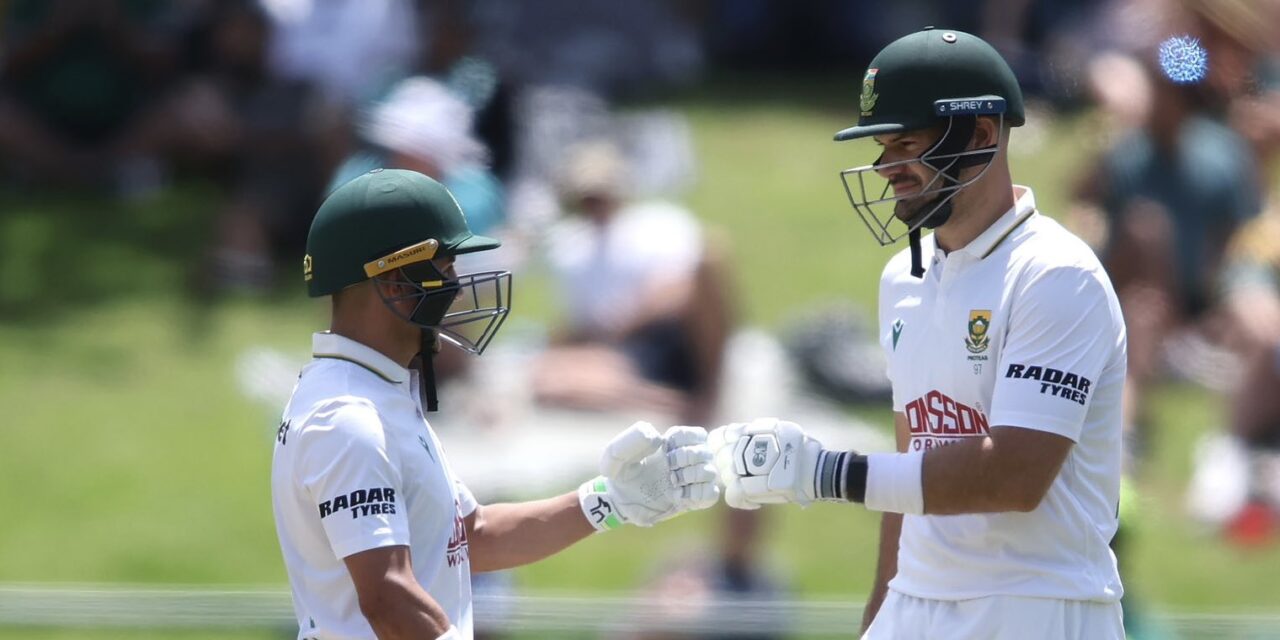
Today, as he reached his third fifty against Australia, Aiden Markram looked purposefully up towards his wife and 4-month-old son, celebrating his milestone with them, for the first time. Will that be one of those moments he will cherish forever?
So, on a very strange Tuesday, in late October, Newlands, under the timeless gaze of Table Mountain, will create its own treasured memories. Cricket nostalgia is not dead, it lives in the minds of those who behold it, at whatever time, and for whatever reason.