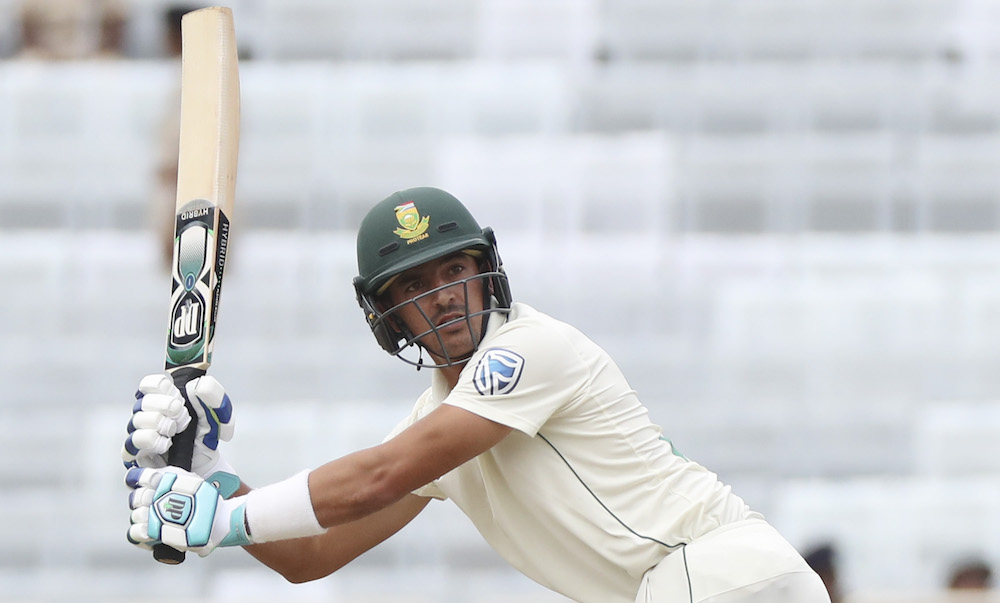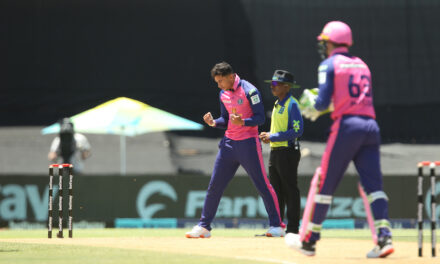
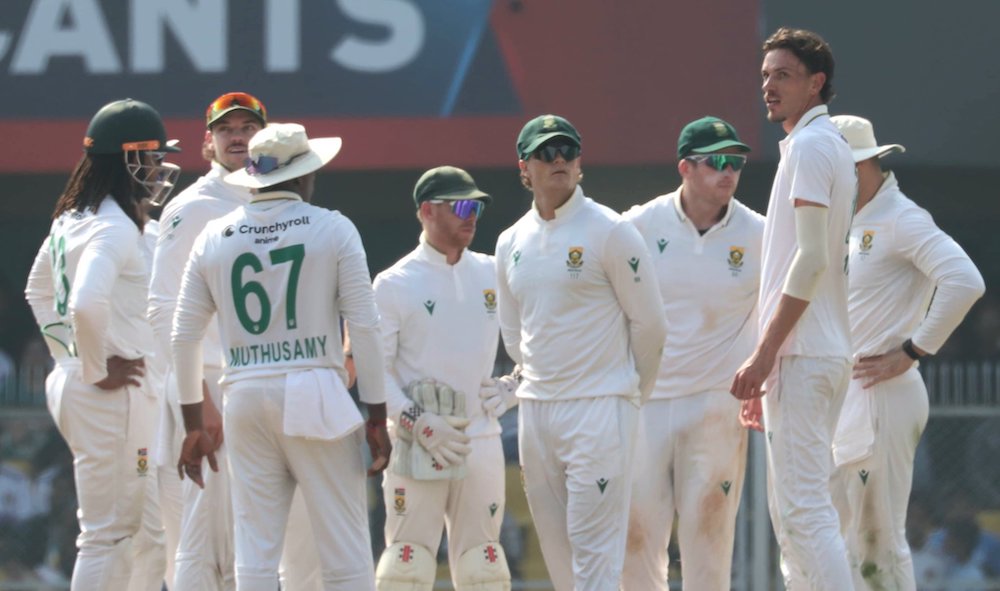
Marco Jansen played the defining hand of Day 3 in Guwahati, ripping through India with 6–48 to bowl them out for 201 and set up a dominant position for South Africa in the second Test.
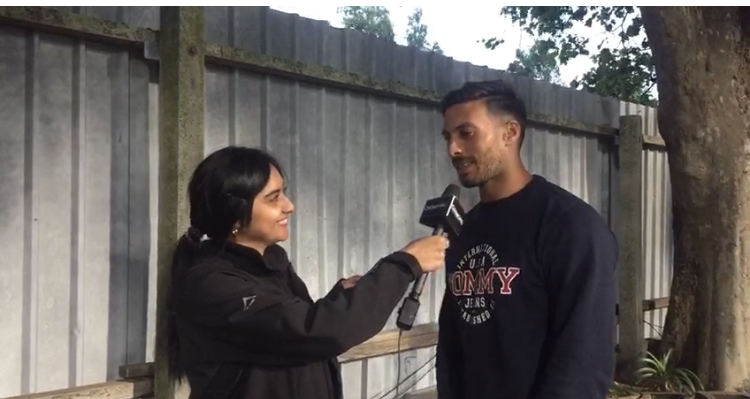
With the Proteas 314 runs ahead, Jansen reflected on extra responsibility, his plans on a lively surface, and why his six-for in India means as much as any spell in his young career.
Jansen didn’t shy away from the weight created by Kagiso Rabada’s absence.
“Obviously, not having KG is a big loss,” he said. “Not having KG definitely adds a bit of responsibility and pressure on myself and Mulder in particular. But for me, when KG plays or doesn’t play, I always try to think of myself as someone who can break the game open for the team. I just try and give my best every time I get the opportunity and try and put the team in a winning position.”
With South Africa extending their lead deep into the match, Jansen said the declaration call would be assessed on Day 4.
“I think we’ll assess tomorrow how things go and then, depending on how the pitch reacts, coach Shuks and Temba will make that decision. For now, the focus is just to get as many runs as possible and then decide according to how the wicket plays.”
Jansen admitted he didn’t expect the surface to offer as much as it eventually did.
“I didn’t think today would turn out the way it did because it’s a good wicket. There’s pace, there’s bounce, and the ball is starting to turn a little bit. Some are stopping from the spinners. If you bowl well, you get wickets. If you bat well, you score runs. You just have to figure out your way of doing it.”
Asked about South Africa’s preparation, Jansen credited the facilities and the group’s clarity.
“The training facilities in Kolkata and now here were very good. What we got in training was similar to the game. I don’t think any team was better prepared. On the day, the guys made the right calls at the right time. India is a good team – you have to be at your best every single ball. The training wickets being so similar helps you wrap your head around conditions, and you can maximise your prep.”
A key feature of his spell was the sustained use of the short ball.
“To be honest, we just said we’re going to try it,” he said. “When I got my first wicket with the bouncer, we said okay, let’s see how long it works. There’s good pace and good bounce here. If you play the short ball well, you’ll score runs. If you bowl well, you’ll get wickets.”
He explained why the new ball was vital.
“With the older ball, it felt a bit softer. It was getting up, but it didn’t have that zip. As soon as we took the new ball, the bounce was still there, but it skidded on nicely. That spell when I took those three wickets, the ball still had pace and bounce. When there’s zip, you try to utilise it.”
Jansen was asked whether India’s batters were vulnerable to the bouncer. He dismissed the idea immediately.
“I don’t think they’re vulnerable at all,” he said. “Nitish Kumar Reddy – I’ve seen him hit the short ball 50 rows back in the IPL. It’s just game situation. When your team is behind, you have to get used to conditions, figure out a plan and then try to put pressure back. That’s Test cricket – sometimes you have to dig deep for 10, 15, 20 overs before it gets easier.”
Reflecting on what a six-for in India means, Jansen said it felt like a breakthrough given his past struggles in the country.
“For me, I’ve always struggled bowling in India. I’m still jealous of people who get the ball to squat and nip back. Yesterday was a perfect example – the ball goes over off stump because I’m so tall. I’ve tried to learn what’s going to work for me here. Today was just one of those days where everything clicked. As a player, those days you take it and you run.”
He also shared a lighter moment about batting nerves during his own innings earlier in the Test.
“I was nervous when I had 20. When I walked in, I faced three balls and Sen looked at me and said, ‘Chom, just breathe.’ I thought I was calm, but clearly I wasn’t. I’ve never been in the 90s before in first-class cricket, never mind Test cricket. I was nervous the whole way.”
Finally, he rated the Guwahati surface highly.
“If I had to pick one, I’d say this pitch. It’s what I call a proper Test wicket – if you bat well you score runs, if you bowl well you get wickets. Kolkata is nice but tough. Here you can set batters up, and you can earn your rewards.”
With six wickets behind him and the Proteas in full control, Jansen’s performance was a reminder of why he’s becoming one of South Africa’s most important multi-format players – with or without Rabada alongside him.