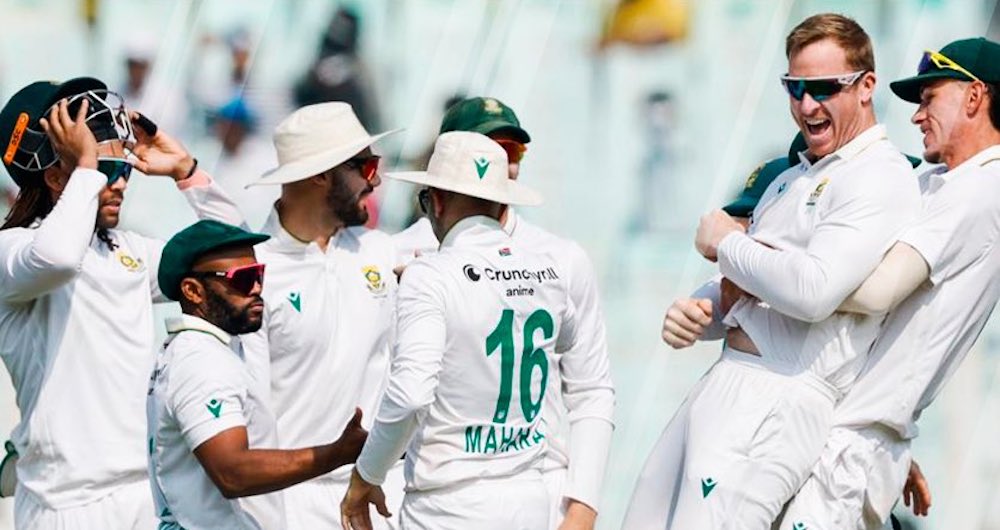
As South Africa gears up for the second Test in India at Barsapara Cricket Stadium, Guwahati, Proteas bowling coach Piet Botha offered insights on the pitch, player fitness, and strategic planning ahead of what promises to be a challenging contest.
When asked about the fitness of spearhead Kagiso Rabada, the coach confirmed that the pacer is still under close observation.
“Rabada is still being monitored by our medical staff. It obviously wasn’t in practice today, but they’ll make a call in the next 24 hours,” he explained.
Botha also provided an update on the pitch conditions, noting both its batting potential and spin-friendly tendencies.
“As far as the pitch is concerned, obviously, they’ll look at it this morning. It’s still two days out, so it’s difficult to predict if they’re going to actually cut more grass off or not. It will obviously make a difference, but what we heard is that it tends to be a good batting wicket up front, and it becomes a spinning wicket later on in the game. But we’ll have to wait and see. Maybe it spins earlier, like the previous Test turned out to be.”
With the second Test starting unusually early at 9 am local time, the coach discussed the impact of the schedule on players’ routines.
“It’s the first time in my career I’m going to have tea first, and then lunch. But with the game starting at 9 o’clock, I thought it would be cooler. It was quite hot at 9 o’clock. But obviously, there will be a little bit more moisture, so I think in terms of the first hour, the new ball should play a role. For how long, we’re not sure. We’ll have to see.
“I know back home in Durban, we start at 9 o’clock, and sometimes the ball goes around for the first hour, and then it settles down, and that side is up to lunch, and this side is up to tea. We prepare as much as we can in terms of both scenarios, where we have to get through various sessions. So for us, it’s just about playing each session on its own, and therefore try to win session by session and not think too far ahead.”
Botha highlighted the growing importance of all-rounders like Wiaan Mulder in balancing the team.
“It’s vital in terms of your team balance to have a player like that. It’s crucial. We’ve actually got three or four guys who can now do a job with both bat and ball, which makes it a little bit better for selection. It’s also guys you can rely on in different phases of the game.
“Hopefully, if you do get a little bit of reverse swing later on, you can play a role there. Obviously, our spin bowlers are also playing a big role in between, so it’s about how we’re balancing that.”
On adjusting to the timing of play and coping with a shifted schedule, the coach emphasised preparation and adaptability.
“It will be different because generally you start the Test match probably two hours later. But fortunately, we started practice this morning early. We got our alarm clock set at 6.30 already. So we are conditioning ourselves to be ready for that. And I think we got the schedule a long time ahead. So mentally, you just prepare yourself for that.
“I think today (Thursday) was good for us in terms of the practice early on. So I think we will be fine. Obviously, adapting to the hours you say. Probably the end of play at 4 o’clock. I saw yesterday that it was already dark by 4ish. But yes, that’s the challenge of playing Test cricket. You have to know how to adapt, and you have to adapt.”
Adaptation to sub-continental conditions with the ball was another key focus.
“It’s just about adapting to conditions. I think it’s what you prepare for in terms of conditions, and then apply our skills to that. So it’s basically just all in our prep, if I’m answering you correctly.
“I think at the end of the day, runs on the board does put pressure on. So I think generally over a five-day Test match, you would tend to want to bat first, try and get runs on the board. But like I think India mentioned, if the ball starts spinning from day one, sometimes it doesn’t really play a role because it becomes a low-scoring game like the last one. And then batting first or second doesn’t play as big a role.
“But if the pitch is going to play decently for the first two days, then you obviously want to bat first. Hopefully, then the wicket does crumble up a bit and spin later on. And that’s the reason you will want to bat first. So you can get those conditions later on and play to your advantage. So I think in principle, 90% of the time you’ll look to bat first if you can.”
Finally, the coach addressed concerns over Simon Harmer’s fitness and India’s heavily left-handed middle order.
“In terms of his fitness, he is fine. He bowled today at Nets. No problems there. Obviously, if the ball spins as early as it did in the last Test, then the majority of the Indian batting lineup are left-handers. That brings him into the game a lot. Also, we balanced him quite nicely with Keshav. He bowled to the right-handers. He got Rahul out in the first innings, which was a big wicket for us.
“It always depends on when you come more into the game as a spinner. Is it first innings or second innings? If it’s first innings and it doesn’t spin as much, I think he is still a good enough bowler just to control the game. Once it starts spinning, then he is obviously a danger. That’s the same for Keshav.”
With the pitch still under inspection and players adjusting to early starts, South Africa will need to rely on adaptability, all-round contributions, and strategic session-by-session planning to challenge India in the second Test.